
Beyond the Grid: When Power Stops Being a Subsystem, Dr. Azam Arastu
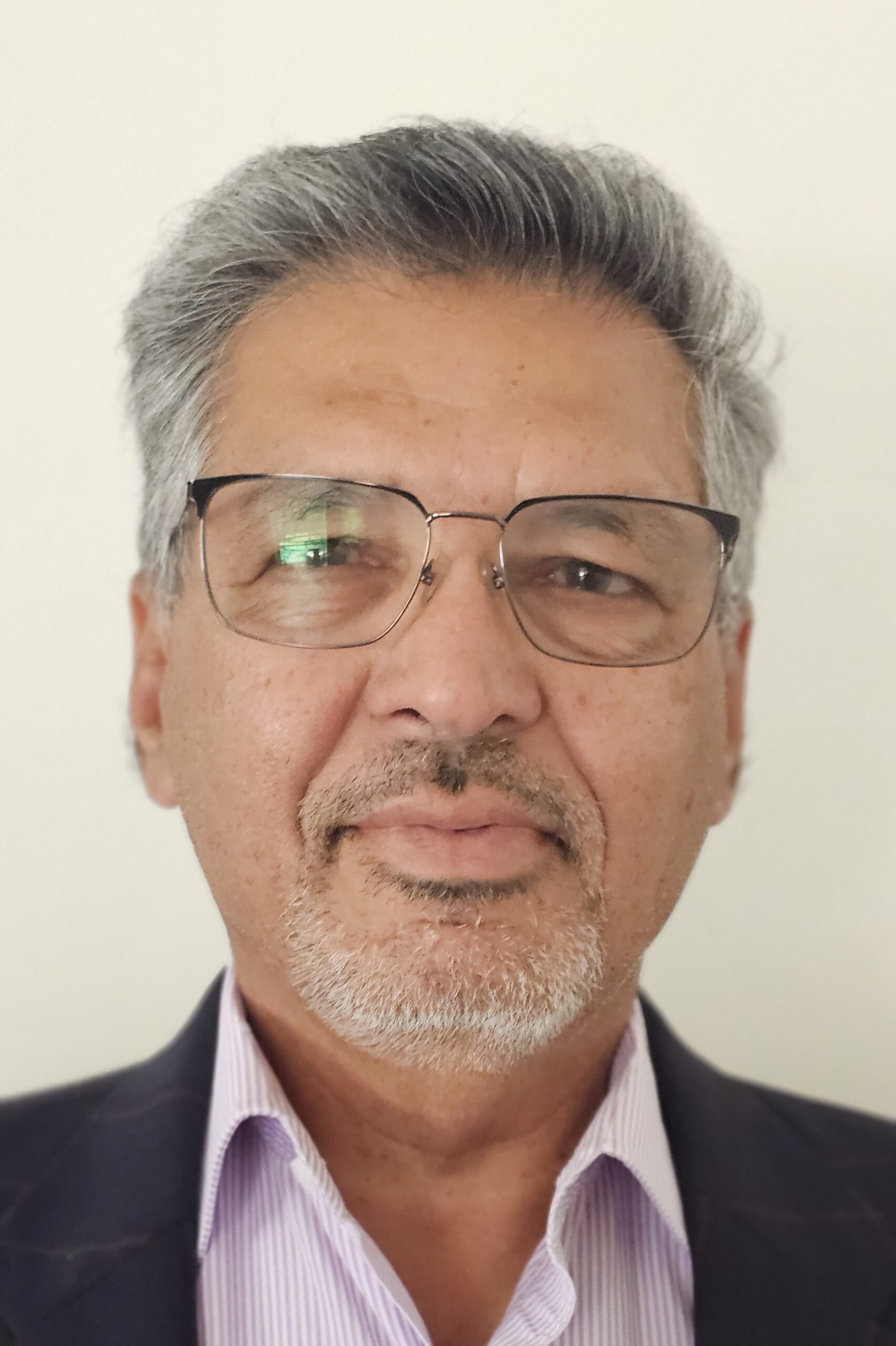
Featuring Dr. Azam Arastu—space power pioneer, aerospace engineer, former Boeing Technical Fellow, former Boeing and Spectrolab executive, and President of AstroSmart Enterprises, Inc.—on why the future of space power is evolving from a spacecraft subsystem into the critical infrastructure that will enable the next generation of space missions ranging from mega constellations, orbital and interplanetary economies, space power beaming, electric propulsion systems, observation and ISR platforms, commercial space stations, etc.
For over six decades, space power has largely been viewed as a spacecraft subsystem—an essential but often invisible capability designed to support a single satellite, space station, or exploration mission. According to aerospace veteran Dr. Azam Arastu, that paradigm is now undergoing a fundamental transformation.
As mega-constellations expand, autonomous spacecraft proliferate, electric propulsion becomes mainstream, and new commercial, civil, and national-security space economies emerge, power is evolving from a mission-specific subsystem into a strategic infrastructure layer that will enable entire networks of space assets.
Over a career spanning nearly four decades, Arastu has helped shape some of the industry’s most significant advances in space power and energy systems. His contributions include helping develop the electrical power system architecture for the International Space Station, pioneering the integration of lithium-ion batteries into spacecraft, advancing high-power electric propulsion systems, and leading the development and commercialization of advanced space solar technologies at Boeing and Spectrolab. Few engineers have witnessed—and helped drive—the evolution of space power across such a broad range of missions, platforms, and technologies.
In this edition of Beyond the Grid, Arastu shares his perspective on how the industry is transitioning from highly customized spacecraft power systems toward scalable, utility-like energy architectures that will support future constellations, lunar infrastructure, orbital manufacturing, space-based communications, persistent ISR networks, and eventually an interconnected space economy.
From Spacecraft Power to Space Infrastructure
Do you believe space power is becoming less about powering individual spacecraft and more about building the energy systems needed to support entire networks?
Azam Arastu: Yes, absolutely.
Historically, the space industry was dominated by large geostationary satellites. These were highly customized, multi-hundred-million-dollar assets where every watt and every kilogram mattered. Power systems were designed specifically for each spacecraft, optimized around a particular mission and operating environment. That model is changing.
Today, most growth is occurring outside GEO. We are seeing massive LEO constellations, autonomous spacecraft, lunar infrastructure, distributed space architectures, electric-propulsion platforms, and entirely new classes of space-based services.
These systems require a fundamentally different mindset. Instead of focusing on a single spacecraft, we increasingly need to think about distributed generation, autonomous load management, dynamic power routing, fault isolation, prioritized load shedding, and network-wide energy management.
Those concepts were not particularly important when power existed only within the boundaries of one spacecraft. They become essential as we move toward larger, more interconnected systems operating as coordinated networks rather than isolated vehicles.
In many ways, space power is beginning to evolve along a path similar to terrestrial power grids—just adapted for a much harsher and more autonomous environment.
The Space Industry’s Biggest Misconception About Power
What lessons from terrestrial energy systems does the space industry still underestimate?
Azam Arastu: One of the biggest misconceptions is that space has unlimited free energy because the Sun is always there.
People look at space and think, “There’s abundant sunlight. Power should be easy.” In reality, generation is only one piece of the equation. Every watt delivered to a spacecraft requires power conditioning, distribution, storage, thermal management, radiation tolerance, autonomous control, and long-term reliability. All of those elements must work together seamlessly over many years with little or no maintenance.
Another common misunderstanding is assuming that scaling is linear.
People often think that if you double the size of a solar array, you simply double mission capability. In reality, larger systems introduce entirely new challenges. Structural dynamics become more complex. Deployment risks increase. Thermal distortions become harder to control. Packaging constraints become more severe. Long-term degradation and operational reliability become increasingly important.
At very large scales, the solar array often becomes the dominant spacecraft structure. The power system begins driving spacecraft architecture, mission operations, launch configuration, and economics.
At that point, you are no longer designing a power subsystem. In many cases, you are designing the spacecraft around the power system.
Why Standardization Matters More Than Efficiency
As the industry scales, what lessons matter most beyond the engineering itself?
Azam Arastu: Standardization. Historically, power systems were highly customized because the missions justified it. But if we are serious about scaling the space economy, we need a different approach. We need repeatable architectures, automated manufacturing, mature supply chains, and production systems capable of supporting thousands—not dozens—of spacecraft per year.
You cannot build large-scale infrastructure one custom spacecraft at a time.
One of the shifts I advocated during my time at Spectrolab was broadening the industry’s focus beyond efficiency alone. For many years, the primary objective was achieving the highest possible solar-cell efficiency. Efficiency remains important, but as space power becomes a larger commercial market, it is no longer the only metric that matters.
Today, system designers must balance efficiency with cost per watt, specific power, stowed volume, manufacturability, scalability, mission flexibility, radiation performance, thermal performance, and overall lifecycle economics.
The objective is not necessarily to build the most efficient solar cell. The objective is to deliver the most value to the spacecraft integrator and ultimately to the mission.
That distinction becomes increasingly important as the industry moves toward higher-volume deployment and larger power requirements.
What Will Matter Most in the Future Space Economy?
Looking ahead, what will create the greatest strategic advantage: access to space, ownership of assets, or access to power?
Azam Arastu: Access to power. Power is becoming an enabling infrastructure layer for virtually every advanced space mission. Just as transportation, communications, and computing became foundational infrastructure on Earth, power is emerging as one of the foundational layers of the future space economy.
Electric propulsion depends on it. Optical communications depend on it. Autonomous systems depend on it. Persistent ISR missions depend on it. Future orbital manufacturing, data processing, lunar operations, and deep-space exploration will depend on it even more.
As mission demands increase, power requirements become more sophisticated. Some applications require continuous baseload power. Others require very large intermittent power bursts. Future architectures will increasingly rely on integrated combinations of generation, storage, power electronics, and intelligent energy management working together as a unified system.
I also see a future where large power platforms support entire fleets of spacecraft through concepts such as space-based power beaming and shared energy networks.
At that point, power is no longer simply supporting an individual spacecraft.
It becomes a shared infrastructure resource serving an entire ecosystem.
The Utility Model Is Coming to Space
When asked what success ultimately looks like, Arastu offered a surprisingly simple vision.
In the future, spacecraft operators should not have to think deeply about power systems at all. They should be able to access energy much like consumers access electricity on Earth—reliably, predictably, and without needing to understand the infrastructure behind it.
“System integrators should be able to say, ‘I need this much power,’ and know they’ll get it,” he explained. “They shouldn’t have to worry about how the energy is generated, stored, managed, or distributed behind the scenes.”
That is the hallmark of a mature utility.
And it may also be the clearest signal that space power has evolved beyond its traditional role as a subsystem and become a foundational element of space infrastructure.