
Beyond the Grid with Mitchell Wiens: The Power Problem Is a Packaging Problem.
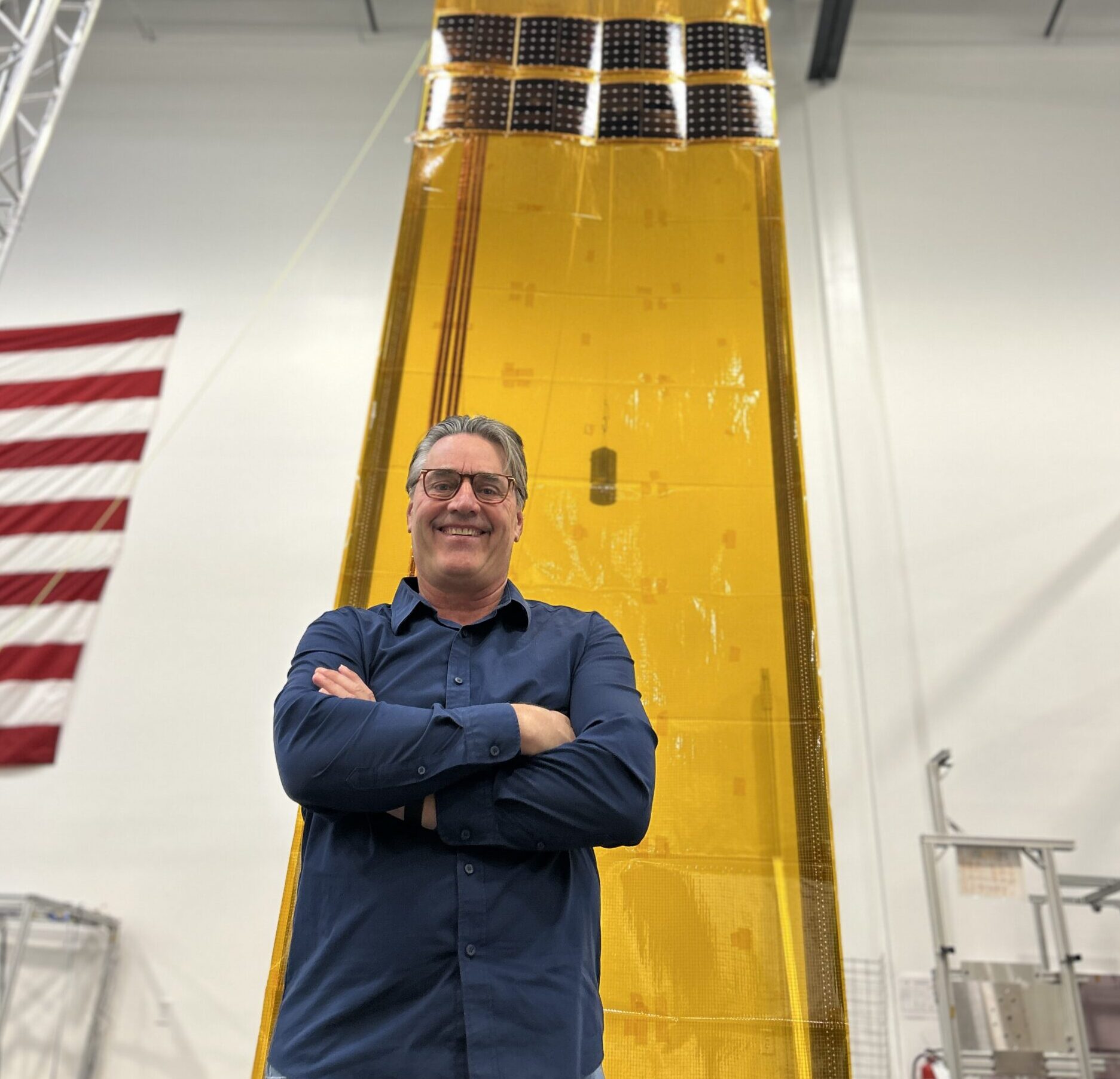
Generating more power in space has never been only a solar-cell problem.
Before a single watt reaches a payload, it has to be packaged, launched, deployed and integrated into a spacecraft already juggling mass, volume, cost and reliability. Proliferated constellations, orbital data centers and future lunar operations all need more power, and they need it in smaller packages, at higher volumes and at lower cost.
Mitchell Wiens has spent nearly four decades on that problem. After early engineering work at Ball Aerospace and Starsys, he founded MMA Space, whose hardware has supported everything from CubeSats to interplanetary missions and defense applications.
In this edition of Beyond the Grid, Wiens discusses why bigger arrays rarely solve the problem on their own, how to balance standardization against customization, and why flexibility may be the most valuable capability as the space economy evolves. For an industry racing to build more capable spacecraft faster and cheaper, delivering more power from less space may be one of the most important design questions of the next decade.
Solar-cell efficiency gets a lot of attention, but generating power is only part of the equation. Where are the biggest engineering constraints emerging at the system level?
At the system level, the biggest engineering constraints stem from mission requirements. As spacecraft are asked to deliver greater performance, whether for large constellations, orbital data centers, or future space infrastructure, those demands flow directly into the design of the power system and the architecture that supports it.
A major challenge is balancing performance with Size, Weight, Power, and Cost (SWaP-C). We have to increasingly prioritize manufacturability, scalability, and supply chain resilience alongside performance in order to drive costs down by an order of magnitude and support the business case.
This has shifted attention to silicon-based solar technologies. While these cells are lower efficiency than premium multi-junction alternatives, they can be produced at significantly higher volumes and lower cost. This requires larger deployed solar array areas to generate the same amount of power, which can present new system-level design challenges.
At the spacecraft level, larger power systems require increased operating voltages, greater current handling, more complex electrical architectures, larger battery systems, and careful management of mass, amongst other things. Additionally, larger deployed solar array wings produce larger inertias with lower first mode/stiffness that drive the need for more capable attitude control systems. This dictates spacecraft size to meet the mission capabilities.
At the solar array level, our team’s biggest engineering challenge remains delivering more power from a smaller stowed package. MMA’s focus has always been on maximizing deployed power from increasingly compact stowed volumes while optimizing overall SWaP-C performance.
What began as packaging strategies for SmallSat vehicles has now become a driving requirement across virtually every class of spacecraft. And even though new and bigger launch vehicle options promise facilitating large constellations and data centers in space, future missions will still demand squeezing as much as possible in a single launch to manage overall cost and schedule.
You’ve spent nearly four decades designing spacecraft hardware. What has changed most dramatically in the way spacecraft designers think about deployable systems, and what lessons from earlier generations of spacecraft do you think the industry risks forgetting?
The most dramatic change, and one that continues to accelerate, is the expectation that deployable systems deliver the same robust, reliable capabilities as traditional spacecraft, but with significantly better SWaP-C, at much higher production volumes and lower unit costs.
The capability of a large spacecraft is now accomplished in a smaller satellite, driving down total mission cost and increasing total mission utility. That shift has fundamentally changed how the industry thinks about deployables.
At MMA Space, we’ve built our business by delivering more deployed capability from smaller stowed volumes, which enables mission planners to maximize mission performance while reducing overall cost. Our approach has been to combine our decades of experience building deployable systems with continuously improving materials, advanced manufacturing techniques, and modern design tools. We’ve developed a flight-proven, high-TRL toolkit that allows us to push the boundaries of performance while effectively managing technical, schedule, and cost risk.
Ultimately, the future of deployable systems is not about abandoning the lessons of the past. It’s about applying those lessons in new ways to deliver more capability than was previously thought possible, at lower cost, and on faster mission timelines.
Mass has traditionally dominated spacecraft design, but today’s missions increasingly have to optimize across mass, stowed volume, power output, cost, reliability, and manufacturability. How should spacecraft developers think about those tradeoffs today, and which metrics do you believe will matter most for the next generation of space power systems?
Today, spacecraft developers need to evaluate power systems through a broader lens than traditional performance metrics alone. The industry’s shift toward commercial space and high-volume constellations means that cost, manufacturability, scalability, and reliability must be considered alongside mass, volume, and power.
One of the most important trends has been the adoption of technologies, production methods, and supply chains from industries such as automotive and industrial manufacturing. Both established space companies and newer entrants are increasingly leveraging high-rate production techniques and terrestrial technologies for space applications. This approach has helped improve affordability, manufacturability, and production capacity while maintaining the reliability required for space missions.
At a technical level, spacecraft power systems remain a balancing act. Mass, volume, power generation, and cost are inherently interconnected, and improving one often impacts the others. The key is understanding which requirement is driving the mission and optimizing around that constraint.
Looking ahead, the most important metrics will extend beyond power density alone. The next generation of space power systems will be defined by delivering more performance in less volume, at lower cost, without compromising reliability or manufacturability.
As spacecraft power requirements increase, from proliferated constellations to orbital infrastructure and eventually lunar operations, does simply building larger solar arrays work, or do we eventually need fundamentally different approaches to how power systems are architected and deployed?
Building larger solar arrays can certainly increase available power, but it is rarely that simple. As arrays grow, they introduce new challenges in mass, stowed volume, structural dynamics, pointing accuracy, deployment complexity, and spacecraft integration. In many cases, increasing array size can create constraints elsewhere in the system, forcing compromises in payload capability, vehicle architecture, or mission operations.
That’s why the industry needs to think beyond simply scaling existing solutions. While innovation in deployable solar arrays remains critical, the bigger opportunity is adopting a more integrated approach to spacecraft design. Power can no longer be treated as a subsystem that’s added after the spacecraft architecture is largely defined. As mission power demands continue to grow, power generation and storage must become important considerations of vehicle design from the earliest stages of development.
At MMA Space, we have always approached deployables as a packaging challenge as much as a power challenge. The goal is not simply to build larger arrays, but to deliver significantly more power from compact stowed volumes while minimizing impacts on the rest of the spacecraft. The next generation of power challenges will require the same kind of creative thinking at the spacecraft and mission architecture level.
We’re already seeing this evolution emerge. For example, new spacecraft form factors, such as large flatsat style architectures, maximize sun-facing surface area for power production while simultaneously providing large Earth-facing surfaces for payloads. These designs reflect a broader shift toward power-aware spacecraft architectures rather than simply larger arrays.
Looking ahead to orbital infrastructure, cislunar missions, and lunar operations, the question will become less about how to build bigger solar arrays and more about how to architect power systems as an integrated part of the mission. Success will come from combining advanced deployable technologies, optimized spacecraft form factors, new materials, and innovative manufacturing approaches to deliver more power, more efficiently, and with greater operational flexibility.
From your experience designing, building, testing, and delivering deployable hardware, where can the industry successfully standardize and where does customization remain essential?
The industry can and should standardize wherever it creates efficiency without constraining mission performance, such as in key spacecraft system interfaces.
Customization, however, remains essential because every mission has unique requirements, operational environments, and performance objectives that cannot be fully commoditized. Mission-specific optimization can be incredibly valuable, but it must be approached with manufacturability and long-term scalability in mind.
Our systems are scalable, modular architectures built on a flight-proven toolkit. This approach allows us to accommodate mission-specific needs while preserving the cost, schedule, and quality advantages that come with COTS.
Ultimately, we believe customizable modularity rather than one-size-fits-all standardization will enable meeting diverse mission needs without sacrificing performance, reliability, or cost competitiveness.
As arrays and other deployable structures become larger and more complex, what innovations will be most important for increasing capability without introducing unacceptable mechanical risk?
As deployable systems become larger and more capable, the key challenge is not simply increasing performance — it’s doing so without compromising reliability. MMA stands for Moving Mechanical Assemblies, reflecting our heritage in designing and perfecting the precision mechanisms that enable our deployable systems. Over decades of development and flight experience, we have built a flight-proven toolkit of highly reliable mechanical components that are engineered, tested, and thoroughly validated.
We see our toolkit as innovative building blocks that enable us to pursue advanced packaging approaches, larger deployed structures, and more ambitious mission requirements without increasing mechanical risk. Rather than reinventing every element of a deployable system, we leverage these proven technologies to solve problems, confident of their performance and reliability. This is not just innovation for the sake of innovation. It’s iterative, purposeful, and to our advantage.
Looking ten years ahead, what mission or capability do you think will force the biggest rethink of how we generate, package, deploy, and manage power in space, and what needs to change today to make that future possible?
Ten years ago, the challenge was largely, “How do we deploy the biggest and most capable structures in space?” Today, the emphasis is increasingly on “How do we deploy large numbers of capable systems efficiently and economically?” as proliferated constellations and commercial space operations continue to expand.
We see our role as enabling all directions. Whether a mission requires a few highly capable spacecraft or thousands of distributed platforms, our focus is on creating deployable solutions that scale with evolving mission needs, regardless of which direction our customers pursue. Because anyone who tells you they can see 10 years into the future isn’t paying attention. The future is now. The demand for capability in space is here, and it will continue to grow. Making the future possible means staying flexible to the evolving demands of the industry.